
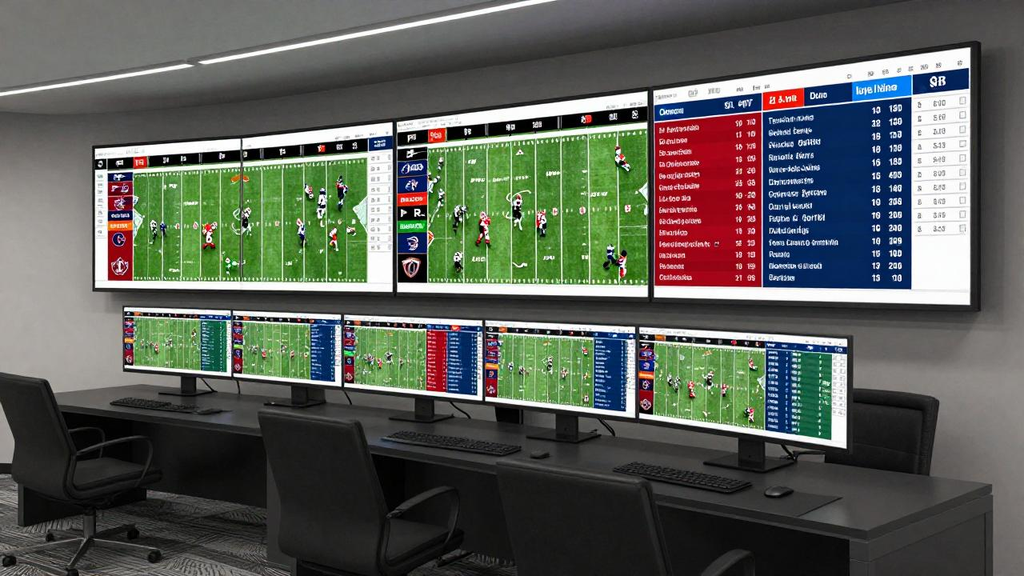
College football betting software has to do something NFL software never has to: handle dozens of games kicking off in the same three-hour window, every single Saturday. With Week 0 openers landing August 27 and the first full slate hitting September 3–5, bookies still running on NFL-era assumptions have about a week left to close the gap and get real college football betting software in place.
Why College Football Volume Looks Nothing Like an NFL Sunday
An NFL Sunday tops out at a handful of simultaneous kickoffs spread across two or three windows. College football doesn’t work that way. The FBS grew to 138 teams for the 2026 season, and a huge share of them play on the same Saturday afternoon — meaning a bookie’s platform has to track live odds, in-play lines, and grading across dozens of concurrent games rather than a tidy handful. That’s the baseline any college football betting software needs to clear before Week 1: software built primarily around NFL Sunday patterns tends to buckle exactly where college football gets busiest, mid-afternoon, when the largest number of games overlap.
The scale of the action matters too. The American Gaming Association projected $30 billion in wagering on the 2025 NFL season alone — and with more than four times as many teams as the NFL, college football spreads a comparable flood of weekly action across a much wider set of games. This is also where an NCAA sportsbook lives or dies on speed: lines move fast when a ranked team is trailing at the half, and a lagging platform costs a bookie real money in missed limit adjustments or players catching stale numbers.
The Features College Football Betting Software Needs Most
Not every sportsbook platform is built for this. The features that matter most for college football betting software are the ones that scale with volume rather than just handling it:
- In-play betting that updates in real time. With so many games running at once, live betting needs to reflect what’s actually happening on the field within seconds, not minutes.
- Deep prop variety. College football props go well beyond the passing-yards-and-touchdowns props NFL bettors expect, such as conference-specific matchups, ranked-team spreads, and total-points markets across dozens of games all need to be buildable without manual line-setting for every single one.
- Simultaneous game handling. The platform itself needs the infrastructure to process dozens of active games without slowdown, especially between noon and 8 p.m. Eastern on a full Saturday slate.
This is where college football pay per head software earns its keep: a bookie isn’t paying for one NFL-sized feature set, they’re paying for a platform sized to handle a full Saturday of simultaneous action.
Setting Limits and Managing Risk Across a Full Saturday Slate
Risk management looks different when a bookie is watching 40+ games instead of 8–10. Per-player and per-game limits need to be set and adjusted across an entire slate, not reset game-by-game manually. Closing that gap is exactly what good college football pay per head software is for: agent dashboards should make it possible to spot which games are drawing outsized action, a ranked-vs-ranked matchup or a rivalry game, for instance, and tighten limits there specifically, rather than applying a blanket limit that either overexposes the busiest games or unnecessarily restricts the quiet ones.
The same logic applies to grading. A platform that grades games automatically as they finish, rather than requiring a bookie to manually close out each one, matters far more on a Saturday with 40 simultaneous finishes than it does on a Sunday with eight.
How PerHead.CR’s College Football Betting Software Supports Bookies
PerHead.CR was built with exactly this kind of volume in mind. Live Betting and the Prop Builder are included standard (not upsells) so bookies can offer real-time in-play lines and build custom college football props (conference matchups, ranked-team spreads, and more) without paying extra for either. Agent dashboards let bookies set and adjust limits per player or per game across a full Saturday slate, and multilingual support in English, Spanish, and Chinese means the software works the same way regardless of which language a bookie’s players use.
Settlement flexibility also matters more during college football season, when a bookie might be closing out 40 games’ worth of action in a single day, PerHead.CR lets bookies choose a Monday or Tuesday settlement schedule so payout timing fits how their week actually runs, rather than forcing every operation onto a single fixed day.
For a closer look at how the live betting side works, see PerHead.CR’s Live Betting software page.
FAQ – College Football Betting Software
Is college football betting software different from NFL sportsbook software?
Yes. College football betting software needs to handle dozens of simultaneous games each Saturday, versus the handful NFL software typically manages on a Sunday. That means faster in-play updates, broader prop coverage, and grading that keeps up with games finishing back-to-back throughout the afternoon.
What should a bookie check before college football Week 1?
Confirm that your college football betting software has live betting and prop markets active for the full slate, that per-player and per-game limits are set correctly, and that agent dashboards are ready to flag unusual action on high-volume matchups before kickoff.
Do I need different software for an NCAA sportsbook than for NFL betting?
Not necessarily different software, but it does need different capabilities. A platform that only handles NFL-scale volume well may fall short running an NCAA sportsbook, where far more games overlap in the same afternoon window.
How does PerHead.CR handle a full Saturday of college football games?
Live Betting and the Prop Builder are included standard, agent dashboards support per-game limit adjustments, and the platform is built to process dozens of concurrent games without slowdown.
Is prop betting bigger in college football than in the NFL?
Prop variety tends to be broader in college football simply because there are more games and more conference-specific matchups each week, giving players more markets to bet on than a typical NFL Sunday offers.
Getting college football betting software right before Week 1 is the difference between a smooth Saturday and constant firefighting once games start overlapping — and it’s exactly what PerHead.CR was built to handle.